

The automotive industry is in the middle of its most significant transformation in a century. Electrification, lightweighting, and the relentless pursuit of tighter tolerances are reshaping how vehicles are designed and built. Underpinning every one of these shifts is a manufacturing capability that rarely makes headlines but determines whether new vehicle programs succeed or fail: precision CNC machining.
The numbers reflect the scale of the opportunity. The global automotive parts CNC machining service market was valued at approximately USD 8.5 billion in 2025 and is projected to reach USD 11.2 billion by 2032. The broader metal precision turned product manufacturing sector, which includes the shafts, pins, bushings, and connectors that populate every vehicle, is expected to grow from USD 121 billion in 2025 to USD 172 billion by 2031. This growth is not driven by volume alone. It reflects a fundamental shift toward components that are lighter, more complex, and produced to tolerances that were unthinkable a generation ago.
Why Automotive Manufacturing Demands More from Machining
Automotive components occupy a unique position in precision manufacturing. They are produced in enormous volumes—millions of parts per year for a single vehicle platform—yet each part must meet dimensional and functional requirements that leave no room for error. A fuel injector nozzle machined a few microns off specification can affect combustion efficiency and emissions. A transmission shaft with imperfect concentricity can generate noise and vibration that customers notice immediately. A battery cooling plate with a rough sealing surface can leak coolant and compromise thermal management.
These demands are intensifying. The shift to electric vehicles has introduced entirely new component categories—stator housings, battery contact pins, inverter components, coolant junctions—each with its own set of precision requirements. Simultaneously, lightweighting initiatives have pushed aluminum and advanced alloys into applications that once relied on cast iron and steel, creating new machining challenges that require specialized process knowledge.
The Role of Five-Axis Machining in Complex Automotive Components
As automotive designs grow more complex, the limitations of traditional three-axis machining become apparent. Components with angled features, curved surfaces, or multi-face geometries have historically required multiple setups—each one introducing the possibility of alignment error and adding to production time.
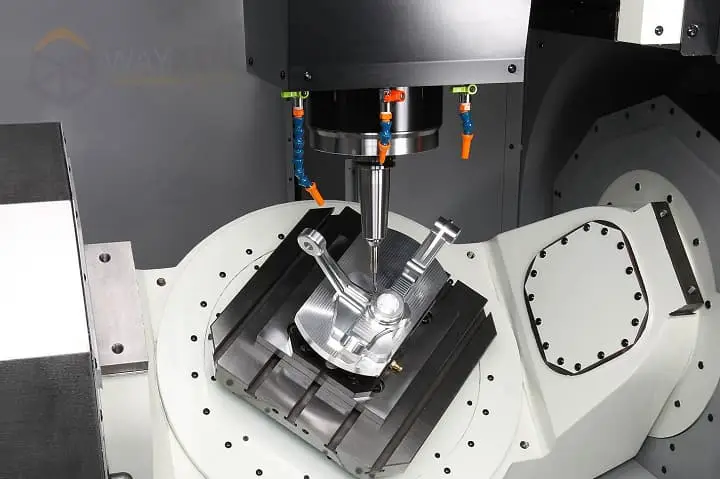
Five-axis machining solves this problem by enabling the cutting tool to approach the workpiece from virtually any direction. Complex automotive components can be machined complete in a single setup, eliminating the tolerance stack-ups that occur when parts are moved between machines. For components like engine brackets, structural nodes, and transmission housings, this capability translates directly to better dimensional consistency and shorter lead times. Advanced five-axis machining has become an essential capability for suppliers serving automotive OEMs who demand complex geometries without sacrificing production efficiency.
The benefits extend beyond geometry. Five-axis machines can use shorter, more rigid cutting tools, reducing vibration and improving surface finish. They can optimize tool engagement angles to extend tool life and reduce cycle times. For high-value automotive components, these advantages quickly justify the investment.
High-Volume Production: Where Precision Meets Scale
The automotive industry’s defining characteristic is volume. A single vehicle platform may require hundreds of thousands—or millions—of identical components, each one meeting the same exacting specifications. A machining process that produces a perfect part on the first attempt but drifts on the thousandth is not a success. It is a liability.
Achieving consistency at this scale requires more than capable machines. It requires a production system built around process discipline: documented tooling strategies, in-process probing that verifies dimensions between cycles, statistical process control that tracks variation across runs, and full material traceability from incoming certification to finished component. High-volume CNC machining for automotive applications is not about running machines faster. It is about building a process that delivers the same result, part after part, shift after shift, without surprises.
For automotive suppliers, this consistency has direct financial implications. Scrap and rework erode margins. Downtime disrupts delivery schedules. Field failures damage reputations and trigger recalls. The manufacturers who have invested in robust production systems avoid these costs—and they are the ones automotive OEMs want to partner with.
Material Challenges in Automotive Machining
The materials used in automotive components present distinct machining challenges. Aluminum, increasingly specified for lightweight structural components and battery housings, machines at high speeds but demands careful chip management to prevent surface defects. Stainless steel, used for fuel system components and sensor housings, work-hardens rapidly if cutting parameters are not precisely optimized. Copper and brass, essential for electrical connectors and busbars, produce long, stringy chips that can disrupt automated cycles.
Each material requires documented process parameters, the right tooling geometry, and effective coolant delivery. Suppliers who have developed process libraries across these material families deliver more consistent results than those still learning on customer orders. For automotive OEMs, this accumulated expertise is not a commodity—it is a strategic asset that reduces risk across the supply chain.
The Reshoring Shift and What It Means for Supply Chains
Supply chain disruptions of recent years have fundamentally altered how automotive manufacturers think about sourcing. The logic of concentrating production in low-cost regions has given way to a more complex calculus that includes geopolitical stability, transportation reliability, and the ability to collaborate closely with engineering teams.
Reshoring is accelerating. Automotive manufacturers are bringing critical component production closer to their assembly plants, driven by a desire to reduce lead times, improve quality oversight, and insulate themselves from trade uncertainty. But reshoring is not simple. It requires domestic suppliers with the equipment, workforce, and quality systems to meet automotive specifications at volume. The shops that have made these investments—in multi-axis machining, automation, and certified quality management—are positioned to capture this demand.
Automation as a Competitive Necessity
The persistent shortage of skilled machinists has made automation a strategic imperative rather than a choice. Precision machining ranks among the hardest positions to fill, and as experienced machinists retire, the gap widens. Automotive suppliers cannot afford to let labor constraints limit their ability to meet production targets.
Automation addresses this challenge directly. Robot-tended CNC cells, automated bar feeders, and lights-out machining enable manufacturers to maintain production with smaller workforces. In-process measurement systems verify dimensions automatically, reducing the need for manual inspection. For high-volume automotive components, automation delivers consistency that human operators, no matter how skilled, cannot match over long production runs.
What Automotive OEMs Should Look For
For procurement professionals and engineering leaders evaluating machining partners, the criteria are clear. Equipment depth matters: multi-axis CNC machining centers with high-speed spindles, automated tool changers, and in-process probing are the baseline for serious automotive work. Quality systems matter: IATF 16949 certification and documented traceability from material certification to finished component provide the audit trail that automotive supply chains require. Material experience matters: a shop that has produced tens of thousands of components in the specific alloys your designs specify understands the subtle behaviors that separate reliable production from costly scrap.
Perhaps most importantly, scalability matters. A supplier who can produce a perfect prototype but cannot maintain consistency at volume is not a partner. Automotive manufacturing is a marathon, not a sprint, and the suppliers who succeed are those who have built their operations around repeatability.
Looking Ahead
The automotive industry’s transformation will continue to accelerate. Electric vehicle production is expanding, demanding more aluminum and copper components than ever before. Lightweighting initiatives push structural designs toward thinner walls and more complex geometries. Emissions and efficiency regulations tighten, requiring more precise fuel system and thermal management components.
For manufacturers supplying this sector, the question is not whether to invest in advanced machining capability—it is how quickly they can build the process discipline, equipment, and workforce required to meet automotive specifications. The technology exists. The demand is measurable. The companies that move decisively will be the ones that lead their industries forward.
